Prithika Pavade: France's Rising Star Redefining European Women's Table Tennis

By: Mark
April 3, 2026 | Updated: April 26, 2026
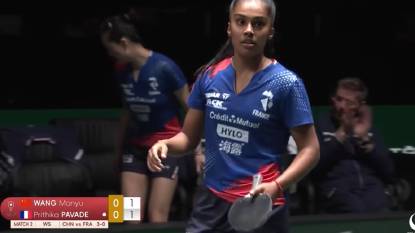

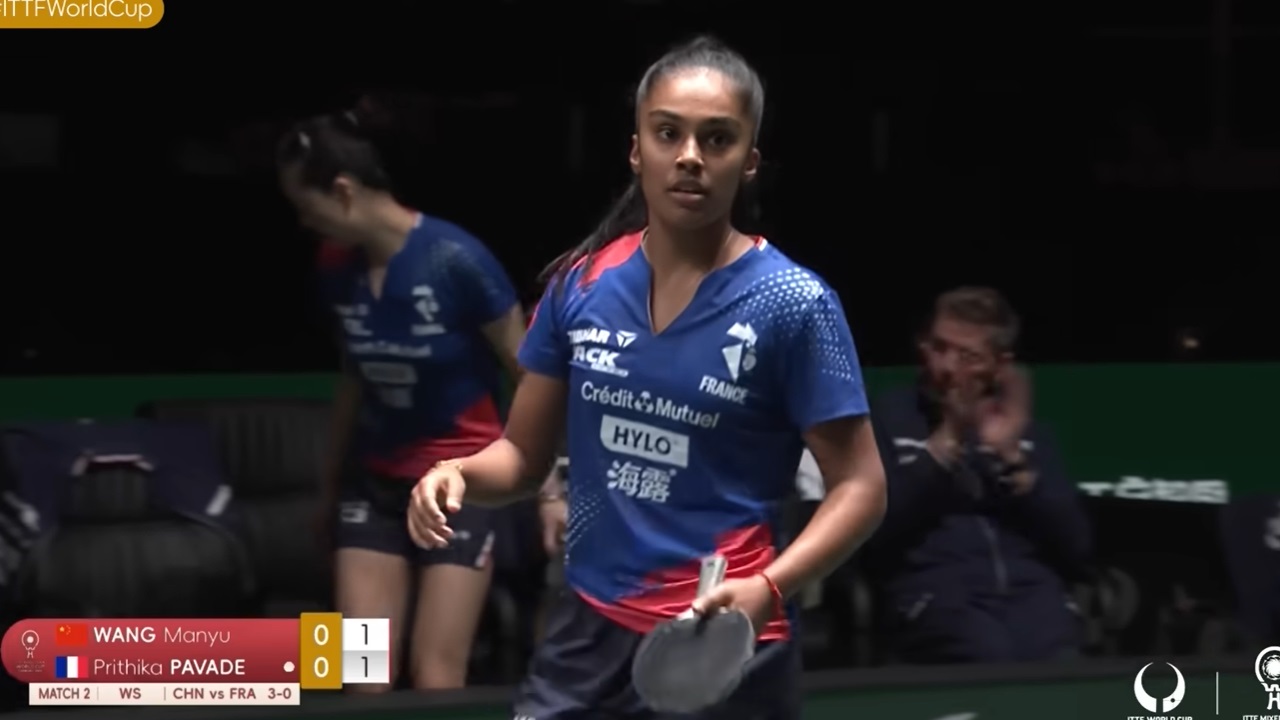
Credit: ©ITTF
Prithika Pavade has rapidly ascended to world #16, establishing herself as Europe’s premier young female talent through a combination of exceptional speed, technical adaptability, and competitive maturity that belies her 21 years. The French left-hander’s Olympic team bronze medal on home soil in Paris 2024 represented her breakthrough to the global elite, while her recent semifinal finish at the 2025 World Championships demonstrated her capacity to challenge Asian dominance in women’s singles.
Despite falling short against China’s Sun Yingsha in her bid to become the first European World Championship finalist since 2013, Pavade’s consistent results on the WTT circuit and emergence as France’s highest-ranked female player signal her potential to redefine what’s possible for European women in a sport where Asian players have long set the standard.
Personal Background
Prithika Pavade was born on August 2, 2004, in Seine-Saint-Denis, a northern suburb of Paris, to parents of Indian Tamil origin who had immigrated to France before her birth. This multicultural upbringing provided Pavade with a distinctive perspective on both sport and life, blending French sporting traditions with the disciplined work ethic emphasized in her family’s cultural heritage.
Her introduction to table tennis came at age seven through a community program at her local club in Saint-Denis, where her exceptional hand-eye coordination immediately caught coaches’ attention. Unlike many players who come from table tennis families, Pavade discovered the sport independently, with her parents initially viewing it as simply a healthy activity rather than a career path. However, her rapid progress soon made it evident that her talent exceeded recreational boundaries.
By age 10, Pavade had begun training at the regional center in Île-de-France, where more structured coaching accelerated her development. Her breakthrough in youth competitions came at 13 when she claimed the European Mini-Cadet (U15) title, announcing her potential on the continental stage. This success prompted invitation to France’s national training center (INSEP), where she relocated to train alongside the country’s elite talents while continuing her education.
What distinguishes Pavade’s background is the remarkable balance she maintained between sporting excellence and academic achievement throughout her developmental years. Despite the intensive training regime at INSEP, she maintained strong academic performance, completing her baccalauréat (French high school diploma) with honors while simultaneously representing France in international competitions. This intellectual foundation complements her athletic capabilities, contributing to her sophisticated tactical understanding and problem-solving abilities on the table.
Pavade’s multicultural identity has shaped her perspective as an athlete. She has spoken about how her Indian heritage instilled values of discipline and perseverance, while her French upbringing provided structured sporting opportunities that allowed her talent to flourish. As she told L’Équipe in a 2024 interview: “My parents taught me that nothing comes without sacrifice and hard work, but they also encouraged me to embrace opportunities that France provided. I feel this dual heritage gives me strength.” No doubt she also felt the strong European influence of players like Timo Boll.
Her emergence as a sporting role model for French youth from immigrant backgrounds has added significance to her achievements, particularly following her Olympic success in Paris. Beyond her technical capabilities, Pavade’s journey represents the positive integration of diverse cultural influences within French sporting excellence.
Physical Attributes & Playing Style
Prithika Pavade possesses a physical profile that perfectly complements her dynamic playing style. Standing at 5'7" (170cm) with a lean, athletic build, she combines compact power with exceptional mobility—physical attributes that support her aggressive, high-tempo approach to the game. Her left-handedness creates natural advantages against predominantly right-handed opposition, particularly in service and first-attack sequences.
What immediately distinguishes Pavade’s playing style is her extraordinary footwork speed, widely regarded as among the fastest in women’s table tennis. Her movement patterns feature explosive lateral transitions with minimal wasted motion, allowing her to cover the table with exceptional efficiency. This mobility enables her attacking style from both wings, as she can rapidly reposition to play forehand attacks from positions where most players would be forced to use backhand strokes.
Pavade’s technical identity centers on aggressive counter-driving with emphasis on timing and placement rather than overwhelming power. She excels in mid-distance exchanges (1-2 meters from the table), where her exceptional read of incoming ball trajectory allows her to initiate attacks earlier than most opponents anticipate. This early timing disrupts opponents’ rhythm while creating temporal advantages throughout rallies.
Her left-handed shakehand grip produces distinctive shot trajectories, particularly on cross-court exchanges where her natural angles create challenging patterns for right-handed players. Pavade exploits this advantage systematically, frequently directing initial attacks to opponents’ wide forehand positions before exploiting the created openings with angled shots to the backhand side.
What separates Pavade from many attacking players is her exceptional adaptability—she can seamlessly transition between aggressive counter-driving, controlled topspins, and defensive blocks based on tactical requirements. This versatility makes her difficult to prepare against, as she rarely relies exclusively on a single approach throughout matches. French national coach Nathanaël Molin has described her as “tactically bilingual—capable of speaking both offensive and defensive languages fluently.”
Her service game features sophisticated variation with particular emphasis on short, low serves with diverse spin characteristics. Rather than attempting winner services, Pavade typically employs serves designed to establish favorable third-ball opportunities that maximize her mobility and attacking capabilities. This strategic approach reflects maturity beyond her years, prioritizing rally advantage over speculative point-ending risks.
In pressure situations, Pavade’s playing style becomes notably more assertive, willingly increasing attacking risk when stakes are highest. This competitive courage was evident during her Olympic campaign, where she produced her most aggressive table tennis in decisive moments of crucial matches. As her physical strength continues developing, this already dynamic playing style is likely to incorporate additional power elements while maintaining the exceptional speed and precision that form its current foundation.
Technical Analysis
Prithika Pavade’s technical profile demonstrates remarkable completeness for a player of her age, with sophisticated elements normally associated with more experienced competitors. Her forehand technique features a compact backswing with exceptional acceleration through contact, generating significant spin despite relatively modest physical strength. What distinguishes her forehand is not raw power but precision and versatility—she can produce topspin, sidespin, or combinations with nearly identical stroke initiation, making her intentions difficult for opponents to read.
Her backhand represents perhaps her most technically advanced weapon. Pavade employs a modern, close-to-table backhand drive with minimal preparation, enabling her to attack balls with immediate initiative from positions where many players would resort to defensive blocks. The technical efficiency of her backhand motion—primarily wrist-driven with minimal arm movement—allows extraordinary speed in execution, critical for her counter-attacking style against aggressive opponents.
Pavade’s service technique demonstrates sophisticated brushing contact with excellent disguise of spin variations. She achieves deception not through elaborate motion but through precise contact manipulation with consistent delivery mechanics. Her short serves feature particularly fine touch, consistently landing within millimeters of the net while carrying heavy spin that constrains aggressive receive options. This technical precision in service execution provides critical tactical advantages in establishing favorable rally patterns.
In receive situations, Pavade’s technical capabilities shine particularly against long services, where her early recognition and compact stroke production allow immediate initiative. Her receive of short services has evolved significantly over recent seasons, developing from conservative pushes to aggressive flips that capitalize on her exceptional reaction speed and timing. This technical development has eliminated a former vulnerability in her game, making her increasingly complete in all phases of play.
Her footwork technique represents a model of efficiency, featuring precise small steps with exceptional weight transfer during transitions. Unlike players who rely on dramatic movements, Pavade’s technical approach to positioning emphasizes constant subtle adjustments that maintain perfect balance throughout exchanges. This technical efficiency in movement contributes significantly to her consistency during extended rallies and pressure situations.
What truly separates Pavade’s technical execution from many talented young players is her adaptability across different playing conditions and equipment variables. In tournaments with varying table speeds, ball types, or lighting conditions, her technique remains remarkably stable—a testament to fundamental soundness that transcends environmental factors. This technical reliability under diverse conditions proves particularly valuable in the modern international circuit with its varying playing environments.
The continued refinement of Pavade’s technical execution was evident during her semifinal run at the 2025 World Championships, where her backhand counter-drive against aggressive topspin attacks notably troubled even elite Chinese opponents accustomed to dictating play against European players. This technical development indicates ongoing evolution rather than merely maintaining existing capabilities, suggesting her technical ceiling remains considerably higher than current levels despite already reaching world #16.
Tactical Approach
Prithika Pavade’s tactical intelligence represents one of her defining strengths, demonstrating strategic sophistication typically associated with far more experienced players. Her fundamental tactical approach centers on controlled aggression—establishing initiative through quality receives and first attacks, then maintaining pressure through precise placement rather than maximum power. This measured approach reflects mature understanding that at elite levels, consistent pressure often proves more effective than sporadic spectacular attacks.
Against Asian attacking players, particularly from the Chinese national team, Pavade employs a distinctive tactical approach focused on disrupting rhythm through timing variation. Rather than attempting to match their power, she systematically alters the timing of exchanges, sometimes accelerating unexpectedly, other times introducing controlled delays that disrupt opponents’ prepared patterns. This disruptive strategy proved particularly effective during her quarterfinal victory over Japan’s Hina Hayata at the 2025 World Championships, where tactical variation neutralized her opponent’s superior power.
When facing defensive specialists, Pavade demonstrates exceptional patience combined with strategic acceleration at precisely chosen moments. Her tactical approach against choppers typically involves extended spin-building sequences while gradually expanding placement range, eventually creating positional vulnerabilities before executing decisive attacks. This methodical approach reflects confidence in her consistency rather than seeking premature winners.
Pavade’s service tactics reveal similarly thoughtful design, with different service patterns employed based on specific opponent tendencies. Against receivers who prefer immediate aggression, she utilizes extremely short backspin services that minimize attacking angles, while against passive receivers, she more frequently employs half-long services with deceptive sidespin that create immediate third-ball opportunities. This opponent-specific service strategy demonstrates her detailed tactical preparation.
In tournament settings, Pavade demonstrates sophisticated energy management and tactical evolution throughout events. She typically employs more straightforward approaches in early rounds, conserving both physical and mental resources while revealing minimal tactical information to potential later-round opponents. This strategic restraint was evident during her 2025 World Championship campaign, where her tactical complexity visibly increased with each advancing round.
What truly distinguishes Pavade’s tactical approach is her exceptional situational awareness—recognizing exactly when to increase risk or prioritize consistency based on score, momentum, and opponent condition. This contextual decision-making allows optimal choices throughout matches rather than applying fixed patterns regardless of circumstances. French national team coach Nathanaël Molin has highlighted this as her most advanced quality, noting: “Many players her age have technical capability, but Prithika possesses what we call ’tactical maturity’—knowing exactly what approach each situation requires.”
Her semifinal performance against China’s Sun Yingsha at the 2025 World Championships, though ending in defeat, demonstrated this tactical intelligence. Despite facing the world #1, Pavade systematically varied approaches to disrupt the Chinese player’s rhythm, winning the second game and threatening in the fourth before Sun’s superior experience ultimately prevailed. This performance against the event’s eventual champion revealed both the effectiveness of Pavade’s current tactical approach and areas for continued refinement as she targets future success against the world’s elite.
Equipment Details
Prithika Pavade’s equipment choices reflect her balanced playing style, prioritizing versatility and control while maintaining sufficient speed for her counter-attacking game. As a Cornilleau-sponsored athlete, she utilizes equipment from their high-performance range, carefully selected to complement her technical and tactical approach.
For her blade, Pavade employs the Cornilleau AERO OFF+ Carbon, a seven-ply wood blade with two outer carbon layers providing an excellent balance of speed and control. This blade selection aligns perfectly with her playing philosophy—offering sufficient pace for her aggressive counter-drives while maintaining the feeling necessary for precise placement and spin variation. The blade’s relatively light weight (approximately 85g) supports her mobility-focused style, allowing rapid transitions between positions without unnecessary fatigue.
On her forehand, Pavade uses Cornilleau Target Pro GT-H47 in maximum thickness (2.1mm). This medium-hard rubber provides excellent spin sensitivity while maintaining sufficient speed for her counter-attacking style. The rubber’s moderate topsheet hardness complements her technique, offering the perfect balance between grip for spin production and catapult effect for speed generation. On her backhand, she employs the same Target Pro GT-H47, creating consistent feeling across both wings that enhances her balanced attacking approach.
Pavade’s racket assembly features a slightly thicker handle than many players use, providing stability during her explosive movements while maintaining sensitive touch for short game and service execution. Her grip features minimal additional taping, maximizing direct feedback from the blade during stroke execution.
What distinguishes Pavade’s equipment approach is her consistency—unlike many players who frequently change setups seeking marginal advantages, she has maintained essentially the same configuration throughout her rapid rise up the rankings. This stability reflects confidence in her equipment choices and recognition that technical mastery with familiar tools typically outperforms constant experimentation.
Her equipment setup produces a distinctive sound during contact—a crisp, medium-pitched impact that reflects the quality of her stroke production and equipment integration. This acoustic signature has become associated with her playing style, immediately recognizable to fans and fellow players alike.
Pavade’s equipment represents the modern European approach to table tennis technology—embracing advanced materials and construction while preserving feeling and control characteristics essential to technically sophisticated play. This balance between traditional values and technological innovation mirrors her playing identity, creating perfect synergy between player and equipment.
Career Achievements
Prithika Pavade’s career trajectory has been characterized by steady progression punctuated by breakthrough performances at major championships. Her crowning achievement came at the Paris 2024 Olympics, where she led the French women’s team to a historic bronze medal on home soil, defeating Japan in the third-place match. Individually, she reached the quarterfinals of the singles event, the best Olympic result by a French woman since 1996. These performances, delivered under intense national spotlight, established her among the sport’s premier talents while creating a national hero in France.
Prior to her Olympic success, Pavade had demonstrated exceptional promise throughout junior competitions. She claimed multiple European Youth Championships medals, including singles gold in the U21 category in 2022. Her transition to senior competition proved remarkably smooth, with consistent results on the WTT circuit establishing her as one of the few European players regularly reaching later stages of international events.
Her most recent significant achievement came at the 2025 World Table Tennis Championships in Doha, where she reached the semifinals before falling to eventual champion Sun Yingsha of China. This performance represented the best result by a European woman at the World Championships since 2013 and firmly established Pavade as a legitimate contender at the sport’s highest level. Her quarterfinal victory over Japan’s Hina Hayata, the world #4, demonstrated her capacity to defeat established elite players in major championships.
On the WTT circuit, Pavade has collected impressive results, including her first WTT Contender title in Lima in January 2025 and consistent semifinal and quarterfinal appearances at Contender and Star Contender events throughout 2024-2025. These performances have propelled her rise through world rankings, reaching #16 by June 2025—establishing her as France’s highest-ranked female player and Europe’s third-highest behind only Romania’s Bernadette Szocs (#12) and Germany’s Nina Mittelham (#15).
At continental level, Pavade claimed bronze at the 2024 European Championships in individual singles, signaling her arrival among Europe’s elite. In team competitions, she has established herself as France’s anchor, leading them to silver at the 2023 European Team Championships, their best result since 2005.
Most recently, at the WTT Champions Budapest in May 2025, Pavade reached the quarterfinals before narrowly losing to China’s Wang Manyu in seven games, demonstrating her continued competitiveness against the world’s elite. This performance contributed to solidifying her #16 world ranking heading into mid-2025.
Pavade’s consistent presence in the later rounds of major championships represents remarkable achievement for a European player in women’s table tennis, where Asian dominance has been even more pronounced than in the men’s game. Her capacity to challenge this hegemony, particularly through her World Championship semifinal run, has established her as one of the few non-Asian players capable of competing for major titles in the current era.
Training Methodology
Prithika Pavade’s training methodology combines traditional French technical development with innovative physical and psychological preparation tailored specifically to her playing style and developmental needs. Based at France’s national training center (INSEP) in Paris, her regimen reflects a holistic approach to athlete development that balances technical refinement with physical conditioning and mental preparation.
Her technical training typically encompasses 4-5 hours daily at the table, divided into specialized sessions focusing on different aspects of her game. Morning sessions often emphasize fundamental stroke production and consistency, with particular attention to service techniques, receive variations, and first-ball attack sequences—elements critical to establishing early initiative in modern women’s table tennis. Afternoon sessions generally focus on tactical implementation through match-play against varied sparring partners, including male practice players who provide increased power and speed to prepare her for elite women’s competition.
Pavade’s physical conditioning has received particular emphasis throughout her development, recognizing that her speed-based playing style requires exceptional fitness to maintain throughout lengthy tournaments. Her program incorporates specialized explosive movement training, rotational core strength development, and endurance work designed to support her dynamic movement patterns across the table. This physical foundation allows her to maintain her speed-based playing identity even during grueling multi-day competitions like the World Championships.
What distinguishes Pavade’s training methodology is its strong analytical component. Working closely with the French national team’s technical staff, she regularly engages in detailed video analysis of both her performances and potential opponents. This data-driven approach informs specific training emphases and tactical preparations, accelerating her development through targeted improvement areas rather than generalized practice. Following her semifinal loss to Sun Yingsha at the 2025 World Championships, for example, Pavade and her coaches conducted comprehensive comparative analysis to identify specific technical and tactical elements requiring refinement to challenge the Chinese elite more effectively.
Mental preparation forms an increasingly important component of her development program. Working with sports psychologists, Pavade has developed sophisticated pre-match routines and in-match focus techniques that maintain concentration during critical moments. This psychological framework proved particularly valuable during her Olympic campaign, where national expectations created unprecedented pressure that she navigated successfully to deliver medal-winning performances.
Her training environment benefits significantly from France’s recent table tennis resurgence, with the presence of men’s stars Felix and Alexis Lebrun creating a high-performance culture that has elevated standards throughout the national program. Though their playing styles differ considerably, the professional standards and competitive intensity they bring to the training center have influenced Pavade’s approach to preparation and competition.
Coach Nathanaël Molin has described Pavade as “exceptionally coachable—combining rare natural talent with intellectual curiosity about the game.” This learning orientation allows her to integrate new technical and tactical elements rapidly, contributing to her accelerated development trajectory. Following each tournament, Pavade typically engages in detailed performance review with her coaching team, identifying specific areas for technical and tactical refinement that inform subsequent training blocks.
Influence & Legacy
Despite her young age, Prithika Pavade has already established a meaningful influence on French and European table tennis that extends beyond her competitive achievements. Her Olympic bronze medal with the French team in Paris 2024 represented a watershed moment for women’s table tennis in France, inspiring unprecedented media attention and public interest in the women’s game. This heightened visibility has significantly impacted youth participation, with the French Table Tennis Federation reporting a 40% increase in girls’ registrations following the Olympics—a “Pavade effect” that may reshape the demographic landscape of French table tennis for years to come.
For young European female players, Pavade provides an accessible contemporary model who demonstrates that challenging Asian dominance remains possible through technical excellence and tactical intelligence rather than attempting to match their traditional power advantages. Her success validates European development approaches while illustrating necessary adaptations for modern competition. This balanced methodology has influenced coaching strategies throughout European programs, encouraging preservation of technical fundamentals while incorporating physical and tactical elements required for international success.
Pavade’s multicultural background holds particular significance in France’s sporting landscape. As the daughter of Indian immigrants who has achieved national sporting heroism, she represents the positive integration of diverse cultural influences within French identity. In a political climate often characterized by tensions surrounding immigration, her success has been embraced across the spectrum, with her Olympic performances uniting disparate segments of French society. Politicians from both right and left have cited her journey as exemplifying successful integration and the strength of French diversity.
Within professional circuits, Pavade’s playing style has influenced tactical approaches through her success against Asian opponents. Her performance against Japan’s Hina Hayata in the 2025 World Championships quarterfinals provided a tactical template that other European players have studied and adapted, demonstrating how speed and timing variation can neutralize power advantages. This contribution extends beyond her personal achievements, potentially reshaping competitive dynamics in women’s table tennis.
For French table tennis specifically, Pavade represents the female counterpart to the Lebrun brothers’ impact on the men’s game. Together, they have reestablished France as a legitimate table tennis power after decades of relative international obscurity. This renaissance has attracted increased financial support and media coverage, creating improved conditions for future generations of French players.
Beyond table tennis, Pavade has emerged as one of France’s most recognized young athletes, achieving popularity that transcends her sport. Following the Paris Olympics, her social media following increased tenfold, and she secured endorsement deals with major French brands including Carrefour and BNP Paribas. This mainstream recognition enhances table tennis’s profile while creating commercial opportunities that benefit the sport’s development throughout France.
While her ultimate legacy remains to be determined as her career progresses, Pavade has already established herself as a transformative figure bridging European women’s table tennis past with its future potential. Her technical excellence, competitive achievements, and ambassador role combine to influence the sport across multiple dimensions, from grassroots participation to elite tactical approaches.
Current Standing & Context Among Peers
Prithika Pavade’s current world ranking of #16 (as of June 8, 2025) places her firmly among the global elite and establishes her as France’s highest-ranked female player. This position reflects her consistent performance over the past two seasons and her capacity to challenge for medals at the highest levels of international competition. Among European women, only Romania’s Bernadette Szocs (#12) and Germany’s Nina Mittelham (#15) currently rank higher, positioning Pavade at the forefront of the continent’s challenge to Asian dominance.
The competitive context surrounding Pavade features a diverse group of elite players with contrasting styles. The top rankings remain dominated by Chinese athletes, with Sun Yingsha (#1), Chen Meng (#2), and Wang Manyu (#3) representing the continued strength of the Chinese system. Japan provides another strong Asian presence with Hina Hayata (#4) and Mima Ito (#5), while South Korea’s Shin Yubin (#8) rounds out Asian dominance in the top 10.
Pavade’s standing within this elite group is defined not merely by ranking but by the respect her technical quality and competitive courage command from fellow professionals. Her capacity to blend exceptional speed with tactical intelligence makes her particularly valued by technical observers appreciative of stylistic diversity in the women’s game. This respect was evident following her semifinal run at the 2025 World Championships, where Chinese coaches specifically highlighted her as representing the future of European women’s table tennis.
Her recent tournament performances provide context for her current standing. Her semifinal appearance at the 2025 World Championships in Doha represented the best result by a European woman at that event since 2013, confirming her emergence as a legitimate contender at the sport’s most prestigious competitions. Similarly, her quarterfinal finish at the WTT Champions Budapest in May 2025, where she narrowly lost to China’s Wang Manyu in seven games, demonstrated her consistent competitiveness at elite WTT events.
Within European table tennis, Pavade has established herself among the continent’s premier talents, joining a small group of players capable of consistently challenging Asian dominance. While veterans like Szocs and Mittelham currently maintain slightly higher rankings, Pavade’s youth—being 5-10 years younger than most of her European peers in the top 20—suggests her trajectory remains distinctly upward as she enters her athletic prime.
In the context of French table tennis, Pavade’s accomplishments have particular significance as she has emerged as the female counterpart to the Lebrun brothers’ impact on the men’s game. Together, they represent France’s strongest generation of table tennis talent in decades, reestablishing the nation as a force in international competition across both men’s and women’s events.
Like a precisely executed counter-drive that redirects an opponent’s power with added spin, Pavade has taken the momentum of increased investment in French table tennis and transformed it into international results that exceed expectations. Her continued development will be closely watched as she targets further improvement against the Chinese elite who still set the standard in women’s table tennis.
Follow Prithika Pavade on Social Media
Prithika Pavade Vs Wang Manyu [Video]
ITTF Mixed Team World Cup 2025 (Stage 2)
Featured Articles
Dive into in-depth stories, exclusive interviews, and expert advice from the world of table tennis. Discover strategies, player spotlights, and behind-the-scenes insights.

Ping Pong Revolution: How Table Tennis Transforms Homes, Offices, and Communities
Table tennis is uniquely positioned as one of the most versatile recreational activities available today. This comprehensive article explores the transformative impact of ping pong across three …
Basic Equipment Needed to Play Table Tennis
What is the basic equipment that you need to get started with playing ping pong? Our guide to the very basic table tennis equipment required to go ahead and start to play. A guide to the basics of …
Is Ping Pong Good Exercise? The Top Health Benefits Explained
Table tennis is great exercise both for mind and body. You can use ping pong to keep fit alongside other exercise programs and raise your overall activity levels to lose weight and keep your mind …
Ping Pong Revolution: How Table Tennis Transforms Homes, Offices, and Communities
Table tennis is uniquely positioned as one of the most versatile recreational activities …
Basic Equipment Needed to Play Table Tennis
What is the basic equipment that you need to get started with playing ping pong? Our guide …
Is Ping Pong Good Exercise? The Top Health Benefits Explained
Table tennis is great exercise both for mind and body. You can use ping pong to keep fit …